





May 182012
 

Resolution is a concept that’s not often considered by designers, but which is often the driving force of the games we create. In this article, I’ll talk a little bit about how to construct a resolution system, and will give several examples of different resolution systems.

What is Resolution?

Resolution is how the rules of the game resolve a conflict between two opposed forces. The following examples below are all those where resolution would come into play:

  • A knight moves into a bishop’s space in Chess.
  • A creature attacks a player in Magic.
  • A player invades a territory in Risk.
  • Two players engage in combat in Dungeon Twister.
  • Two players are attempting to hit one another in BattleCON.

In each of these situations, the resolution system is what decides who wins the conflict and to what degree.

Chess – No Resolution

In some games, resolution is not important. In the Chess example, we see that the attacking piece always wins the conflict. Since the winner is pre-determined, this is not resolution at all, and certainly not an interesting resolution. However, sometimes it is the right move. In Chess, resolution arises in more complex ways, which I’ll talk about a little more later on.

The takeaway from this part of the article, though, is that a resolution system is optional, and including one is not always the right choice for a game designer.

MTG Creatures – Numeric Comparison

Now we come to interesting resolution–situations where either player can potentially win. In Magic the Gathering, creatures has power and toughness. A creature destroys the other if his power is greater than his pair’s toughness, and is destroyed when his toughness is less than his pair’s power. We’ll ignore in this example the possibilities of multi-blocking and instants, but will come to those later. If we ignore those variables and just consider creatures, there are four outcomes: neither creature dies, only A dies, only B dies, or both A and B die.

This kind of resolution is determined by a simple numeric comparison. That is, it is not the rules of the game that explicitly state the winner (like in Chess, attacker always wins) but rather the instance of the combat itself.

You might say that this is identical to the resolution in Chess, since the outcome is known before the conflict begins, and you’d be right to some degree. What makes the direct numeric resolution interesting is not the resolution itself, but the decisions that lead up to it (which creature will be used to block, which instants will be played, and how each player weights the desirability of the four different outcomes).

The important takeaway here is that a resolution system doesn’t have to be interesting in and of itself to be a good resolution system. Sometimes a simpler system, like the one that has powered Magic for nearly twenty years now, is not a bad pick.

Risk Invasion – Playing the Odds

So let’s consider another possibility. Let’s say that you don’t know what numbers your opponent has. Maybe you only know your own numbers, and maybe you don’t even know those. In a Risk Invasion, the attacker can roll 3d6 and the defender can roll 2d6. The attackers’ highest die is paired with the defender’s highest die, and the second highest dice from each side are paired together. Higher number wins, defender wins ties.

In this scenario, a random factor has been added to the numeric comparison. The random factor is one that cannot be pre-determined, so the attacker has no way of knowing whether or not he will win the conflict. The only informing factor that the player can use to make a decision is how badly he wants to conquer the territory in question.

One thing you might realize in this example is that it’s not so different from the others–just like in Chess and Magic, the outcome is already decided. Since neither player’s choices will affect the outcome, the only difference in Risk is that the winner of the conflict is not known before resolution begins. That is, the random factor obscures the outcome, and forces the player to make his decision based on a valuation of the potential outcomes (that is, how important the territorial conquest is) and not on his ability to calculate the end result of the resolution.

Is Risk resolution more interesting than Chess or Magic (our abbreviated Magic from above)? I’d say yes. Forcing the player to choose based on his valuation rather than on knowing whether he will win or lose provides a more interesting experience for the player. In this case, what we see is that obscuring the outcome (by introducing randomness) forces the player to make a more interesting decision than resolution without the random factor. This is also called a Single Blind Selection, since the player must make his choice without knowing the outcome of the choice.

Dungeon Twister – Double Blind Trump Resolution

I realize not everyone reading will have played Dungeon Twister. If not, it’s an excellent game, and I’d recommend it to you for a look at how very deep, tactical two player games are built. In Dungeon Twister, two opposing players meet in a corridor, and so they decide to fight. Each player has a hand of cards marked 0 through 5, and the player who plays the highest card wounds the other, and in a tie neither loses (some characters have bonuses to attack, but we’ll glaze over those for now and assume we have identical characters). After the resolution ends, the cards used are lose forever (except 0, which returns to your hand after each fight).

What becomes immediately apparent is that as a single resolution, the game isn’t interesting. Both players should pick 5, end of story. However, taken as multiple resolutions (say we are going to do 5 different combats), then conservation matters. The player will wish to beat his opponent by 1 (the minimum to win) or to play zero if he believes he will lose. If A uses 5 and B uses 0, then B automatically wins at least one combat later in the game (because A can no longer win if he plays his five). In the scope of the entire game, this is important because it changes the weight of the different plays. My best play is based entirely on what I believe you will do, and no play is actually better than another play.

This is also an example of a Double-Blind Decision, since two players are making selections based on their beliefs about their opponents. If I believe you will choose 5, you want to choose 0, but if you believe I will choose 0, you want to choose 1. The other thing to realize here is that if you’re playing with identical payoffs and beliefs (1 is as reasonable to play as 2 for both me and you), then double-blind decision is actually identical to single-blind resolution. It is the external conditions of the game (how many more conflicts will there be? How much do you want to win? How much do I want to win?) that alter valuation, and the understanding of my opponent’s valuation that makes the trump resolution here interesting.

Shifting from a single-blind to a double-blind decision has moved the focus from our own valuation to an assessment of our opponent’s valuation (and also to the opponent’s assessment of our assessment of the opponent’s valuation, and so on). David Sirlin, the designer of Yomi, has an excellent series of articles about this topic on his own blog, so you can read more on those if you want to learn all the in’s and out’s of double-blind decision making.

The big idea with a trump (and even more so with a circular trump, like Rock-Paper-Scissors) is that it is the external conditions of the game as a whole that make this resolution different than simple random resolution.

BattleCON attacks – Multiple Axes of Resolution

So we’ve talked about a few different kinds of resolution systems, but none of them have really been big enough to constitute a deep game. In fact, each of these resolutions has been a smaller game inside of a much larger game.

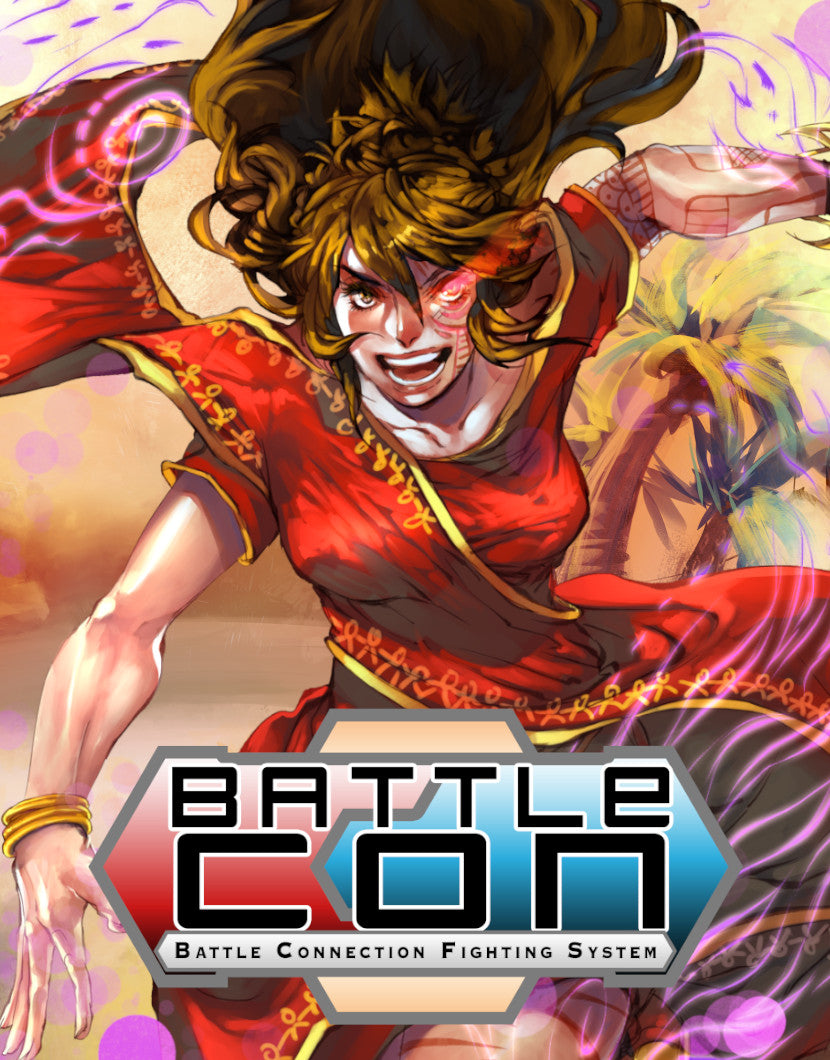
I’m going to talk for a bit about a game that’s near and dear to my heart, and that’s BattleCON. BattleCON is a dueling game where the entire game is essentially one large resolution system–rather than a resolution system being a small component of the game (contrast Risk, where you take a turn, and sometimes there’s a conflict, in BattleCON, you have a conflict, and sometimes there are turns).

In most of the game’s we’ve discussed so far, there is one axis of resolution–the higher number (or the attacker, in Chess) wins. In games where resolution systems are more prominent, there are multiple axes of resolution. That is, multiple variables or decisions that the player has to make. In BattleCON, there are four major axes of resolution: Range, Power, Priority, and Stun Guard. Each factor alters the payoffs of the other factors, and the payoffs (the winnings) for a particular play are the amount of damage you do to the opponent, minus the amount of damage you take from the opponent). For the sake of the example, I’ll explain the stats briefly in terms of these winnings.

  • Range – If your attack is in range, then it will hit. Otherwise, you will do no damage. If you don’t have range, you don’t have anything.
  • Priority – Higher priority gets to execute their attack first. Since you can stun your opponent and prevent his attack, priority is a big deal.
  • Power – Determines how much damage you do and thus how much closer an attack brings you to winning, also useful for breaking Stun Guard.
  • Stun Guard – Stun Guard lets you counter-attack if you’re slower. Now priority doesn’t matter, you just need higher power to win a trade.

So there are multiple strategies a player can take, based on what he thinks his opponent will do and what he knows his opponent is capable of. Each axis trumps another axis, while at the same time being trumped by others. As one player stated, “Priority is everything… until its completely meaningless.” You can have a priority of 10 to your opponent’s 1, and they can still beat you just by stepping back out of your range. You might have the range to cover the whole board, but if your opponent can make the fast drive in to hit you first and stun you, it doesn’t matter one bit.

I’m not going to break down all the intricacies of BattleCON’s resolution, as there’s another long article on all that, but suffice it to say that to create truly complex and interesting resolution systems, you will probably want to integrate multiple axes of resolution, each with a subtle impact on the others. This makes valuation and strategic decisions more intricate, and also allows you more design space to work within while designing your game.

External Repercussions

Another compelling aspect of a rich resolution system was something I stumbled upon almost by accident. A playtester mentioned to me when working on BattleCON: “One of the things I like most… is that there are repercussions beyond just whether my attack hits or misses.” It was a happy accident of ranges and rotating discard piles that every possible game state definitively favored one player over the other, so much so that even if you could land a solid hit, it might be more useful to choose a move that set up a better tactical position instead. As we saw with Dungeon Twister, the external conditions of the complete game bleed into the resolution system, and in most cases this can only be a good thing.

Even in Chess, where the resolution can’t get simpler, it becomes apparent that pressure chains (sequences of pieces all defending the same square) form a more complex system of resolution than our first look at resolution appeared to facilitate. That is, even a dull and straightforward resolution system can become quite compelling when the game surrounding it provides an interesting enough macro-resolution.

In Conclusion

  • The resolution system is the control panel by which a designer manipulates how decisions will be made within the game.
  • There is no right or wrong resolution system–each facilitates a different kind of player-experience, and is well suited for a different kind of game.
  • An unknown element can create tension in resolution systems. If that unknown element is an opponent’s decision, the game can become extremely intense.
  • A resolution system is important not only in how it resolves conflicts, but how those conflicts integrate into the larger picture of the game.
  • By adding more dimensions to your game’s simulation, both inputs and outputs, you can create a system where the decisions made by the players can force them to formulate new valuations and make decisions that will affect not only a single instance of resolution, but the game as a whole.
  • The formation of new valuations–discovering new solutions to new problems presented by the opponent (and in turn their discovery of new solutions to thwart your solutions), is what keeps resolution-oriented games focused.

For your next game, you might be faced with the question of how to resolve conflicts between players and obstacles, or between multiple players’ interests. Before you make the decision too quickly, think hard about the kind of experience your game aims to create and how your resolution will accomplish it.


Welcome to Idylls of Empyrean! This is a column dedicated to improving your Mystic Empyrean games. In Idylls, we’ll discuss various aspects of Mystic Empyrean’s storytelling structure, character developments, and plot building. It is assumed that readers are familiar with the basic premise and ideas of Mystic Empyrean. If you are not, check out the free preview game which is available for download and play at no cost.

This column will eventually move to its own, dedicated space, but for now, it shares the same space with the rest of the Level 99 Games announcements and blogs.

Everyone is a GM

The Game Master (or GM) is the most important element in any roleplaying game, and Mystic Empyrean is no exception. Where Empyrean differs from other roleplaying games is in the way it distributes the job of the game master. The role is split three ways, and understanding this split will improve your gameplay and enjoyment of Empyrean immensely. The three primary roles of the game master in a traditional RPG are:

  • Arbiter
    • The arbiter is responsible for resolving conflicts between the players and the world.
    • The arbiter is responsible for controlling the actions of neutral and hostile entities in the world.
  • Planner
    • The planner is responsible for building the world and fleshing out its history and inhabitants.
    • The planner is responsible for facilitating encounters and situations which are interesting to the players.
  • Storyteller
    • The storyteller is responsible for creating story hooks that draw the players into the world and give them conflict to pursue.
    • The storyteller is responsible for deciding how the players’ actions alter the world.

Each of these three roles is divided up in different ways, not only among the players at the table, but the owners of specific elements, and even the game itself. Let’s take a look at each role and how it breaks down for Mystic Empyrean.

Arbiter

In simplest terms, the Arbiter’s job is to decide “what happens when I do X”. This is the lowest and most straightforward role of the GM. When I leap from a burning tower, do I sprain my ankle or break my neck? When I fire my weapon at the basilisk, do I take out its eye, or do I put a hole in the wall beside it? In Empyrean, the result of the action is decided by the game via a balance draw, but the actual outcome–the repercussions of the attempt, are decided by the current player GM.

In Empyrean, death is hard to inflict on players, and serious failures, such as being crushed to smithereens or losing an eye provide only temporary setbacks. This is by design–so that player GMs can inflict all manner of horrors and distress on their allies without having to worry about the long-term repercussions of the penalties they mete out. There are no wounds in Empyrean that are ‘too harsh’ to inflict on your fellow players, and the harsher the situations you put players into, the more telling their persona traits will become. Everyone reacts pretty much the same way to a scratch, but the reaction to losing an arm, watching a mortal ally be killed before your eyes, or having your favorite weapon turned against you will be much more telling for a player’s personality development.

When acting as arbiter in Empyrean, players are encouraged to be brutal and harsh. Success is almost always attainable for Eidolons who are willing to shed some of their power (via Anima Surge), so the penalties for failure should be severe. The decision of whether to burn Anima to avoid whatever unknown harm will come from failure should be a serious one, and is especially telling of the character’s morality and creed–at least, it will be if he knows the penalty for failure is going to be significant. Even though your characters are immortal, the world still plays for keeps, and it is a world full of danger that would quickly end mortals (and careless immortals, too).

The second role of the arbiter is to control the world. The game itself provides some outlet to help the GM here, in the form of using the action table in reverse. In this case, as before, only the outcome of the action taken by the enemy needs to be described. While the GM can fully narrate the outcome himself, he can also offload this responsibility to the player–allowing a successful player to describe the outcome instead of describing it himself. This gives the player additional freedom to express the way his Eidolon deals with the situation, instead of placing the burden on the GM.

Planner

The role of planner is given entirely to the players in Mystic Empyrean–the game itself offers little in the way of pre-defined plots or world, and instead relies on the players to supply these elements. There are two ways to accomplish this–by pooling the group together, or giving a single player control of creating the realm. Each has its own advantages, and a mixture of both is recommended for most groups.

When a player is particularly inspired to create a specific realm and tell a specific story there, it is good to give this player complete realm ownership and let him craft the realm completely on his own. This gives him the opportunity to create a tightly knit scenario for the realm, which the players can then embark.

When the party simply wants to explore and experiment, public realms can be created by the group realm creation rules. A public, group-created realm gives players more comfort in playing the game and creating encounters. With no solid definition of the realm owner and no complete vision of the realm to violate, players are more free to adapt the realm to fit the kind of encounter or story they envision, and are more prone to update and influence the realm as they play, through the method of establishing and closing questions. Especially for publicly created and maintained realms, closing questions are an excellent way to enhance the depth and character of the realm.

The second role of the planner, hooking the players into the world, is accomplished via Personal Stories and the Scenario. These roles are distributed among the party, making each player integral to the backstory development of the others. Personal Stories are a good idea for inclusion in almost all games of Mystic Empyrean–they serve a dual role of getting players involved in each others’ backstories, as well as giving players a background story and a life beyond just adventuring that makes them more relatable and memorable.

Storyteller

The first job of the storyteller is also split into two parts between the game and the players. Empyrean’s extensive set of context-generation tables will generate the basic plot for an adventure, but the parameters and specifics of this plot are laid out by the players during the establishing questions step. For those who want to explore randomly in Empyrean, the game can generate new encounters and challenges that will test your creeds and grow the world organically via establishing questions. For those who desire a more structured adventuring experience, a Scenario Owner can take on the role of storyteller and script encounters that will lead the party on an episodic epic.

When a traditional Game Master plans his complete game, he usually concocts only a nebulous idea of the encounters, making notes of only a few specifics–what hazards might appear, what monsters will the party fight, and what villains will they encounter. When the players ask questions about their surroundings, or when they take the left path versus the right, typically the game master is playing “off-the-cuff” and making up the adventure as he goes along, steering things towards the planned conclusion for the encounter.

Empyrean accomplishes this “off-the-cuff” play though its establishing questions. As for steering the party towards the desired conclusion, there are two options available for the scenario planner. One option is to answer all of the closing questions for an encounter yourself–simply tell the players how their actions have affected the world. The second option is to create a montage, where you simply describe to the players what transpires between this encounter and the next.

This style of running a game is often called “railroading”, where rather than giving the players a true open world to explore, they are instead shipped from resolution to resolution by the scenario owner. Empyrean encourages this style of play by discarding elements like skills, traps, money, and even game maps. Players do not need to look for traps, scavenge for treasure, or search for secret doors. Instead, the game experience is boiled down to the most important part–how the players solve conflicts they are presented with. This is not to say that finding a trap or searching for a door can’t be the central conflict in an encounter, but in most cases, where the way the party proceeds won’t be affected, these elements can be distilled out of the game. A player is not required to actually walk to a dungeon, to find a certain person in a bar, or carry a treasure from the dark temple back to town. Unless there is actually a chance of failure or an opportunity to change the story’s outcome, these trivialities should be dismissed.

The planning sheet included with the Mystic Empyrean corebook is a series of lines connecting various events, allowing significant choices to branch to significant outcomes. The scenario owner who is managing the game as a whole should consider what parts of the encounter fall into these boxes, and which fall into the lines, and thus glazed over.

Becoming a Better GM

Game Mastering is a learnable skill, and there is a significant amount of writing on the topic. For those who desire extensive reading on the topic, www.campaignmastery.com is just one great resource for beginning GMs. Of course, practice is the rule if you want to improve. Empyrean is designed to let players ease into the role of game master, beginning only as arbiter, and then taking on role as storyteller and planner as they become more comfortable with these aspects. Keep the roles of the GM in mind when playing, and try to stretch your reach by trying out new ones as your games progress.

Vacation

 Apps, Blog, News  Comments Off
May 032012
 

Starting next Monday, I’ll be heading off on vacation with my parents-in-law, meeting the extended family and such for two weeks. Since I’m the only person on staff here at Level 99 Games, there won’t be anyone to make posts and answer emails.

The BattleCON app is currently submitted to the app store, so it will probably be after I’m gone that it actually comes out. Please download it and leave a review when it does!

I’ve put together a few posts that should auto-release at intervals during the week and provide new Level 99 Games-related content. Be sure to check www.battleconnection.com and www.mysticempyrean.com for timed updates regarding BattleCON and Mystic Empyrean, respectively, as they’ll also both be on automatic update schedules.

Items purchased in the Level 99 Store will not be shipped until May 21st, when I return. If you plan to purchase something during my vacation, please keep this in mind!

© 2012 Level 99 Games Suffusion theme by Sayontan Sinha